
The digital-asset investment partner for institutions.
Outerlands is an SEC-registered investment adviser providing investment expertise, infrastructure, and execution capabilities to token foundations, investment advisers, and institutional allocators.
Investment Management
Institutional portfolio construction and delegated investment management across digital assets, informed by quantitative research, fundamental analysis, and disciplined risk management
Advisory
We serve as an extension of our clients’ investment teams, advising across portfolio strategy, treasury management, investment diligence, risk management, and implementation
Technology & Execution
Our proprietary platform, Katalepsis, provides institutional portfolio management, risk oversight, and algorithmic execution across digital-asset markets


Built for Institutions Navigating Digital Assets
Token Foundations
Outsourced investment and treasury management spanning portfolio strategy, liquidity, risk management, and execution
Investment Advisers & Asset Managers
Specialist digital asset capabilities that extend your investment organization without requiring you to build them internally
Institutional Allocators
Independent expertise across digital asset allocation, diligence, portfolio construction, implementation, and ongoing oversight

The broader crypto market has been weak for a while now, but one accusation that won’t stick is that everything is just moving with Bitcoin.

Turns out - not that much! Digital assets generally have a lower correlation to equities (~0.33) than equities do to fixed income (~0.60)!

Tokens had a tough year: the average return for projects that started 2025 in the top 100 (ex memecoins) was -51%, while more than half the tokens declined by more than 72%. Only 8 tokens actually went up.
On the other hand, fundamentals meaningfully improved in most cases.

If you hold Bitcoin and Ethereum, you probably think you have decent exposure to the Web3 economy. Think again.
Bitcoin and Ethereum remain the dominant digital assets by market cap, representing over 80% of the market cap of the Top 100 tokens. But despite this skew in valuation, Bitcoin and Ethereum don’t necessarily reflect the majority of digital asset activity.

The latest bout of market uncertainty briefly brought Bitcoin down about 20% from the highs of the last 90 days. While the move feels extreme, it’s worth remembering how frequently this still happens for Bitcoin, the oldest and most stable of digital assets, even in up-trending markets.

The past few weeks have brought their fair share of volatility, but altcoins have generally performed well over recent months. Whenever this happens, talk inevitably turns to the idea of another “alts season” - a term that has been used to describe broad, indiscriminate rallies across the altcoin market in the past. Many investors still look back to 2021 as the benchmark for such periods. Realistically, though, that kind of market environment isn’t a healthy goal.

Digital assets just cleared another major milestone: The SEC has approved generic listing standards for ETFs (or specifically, “Commodity-Based Trust Shares”) that explicitly cover certain digital assets. By our count, only ~14 assets currently qualify, and the list is dominated by Layer 1s and currencies, with a few memecoins as well. Notably, these are also some of the more richly valued projects in the market.
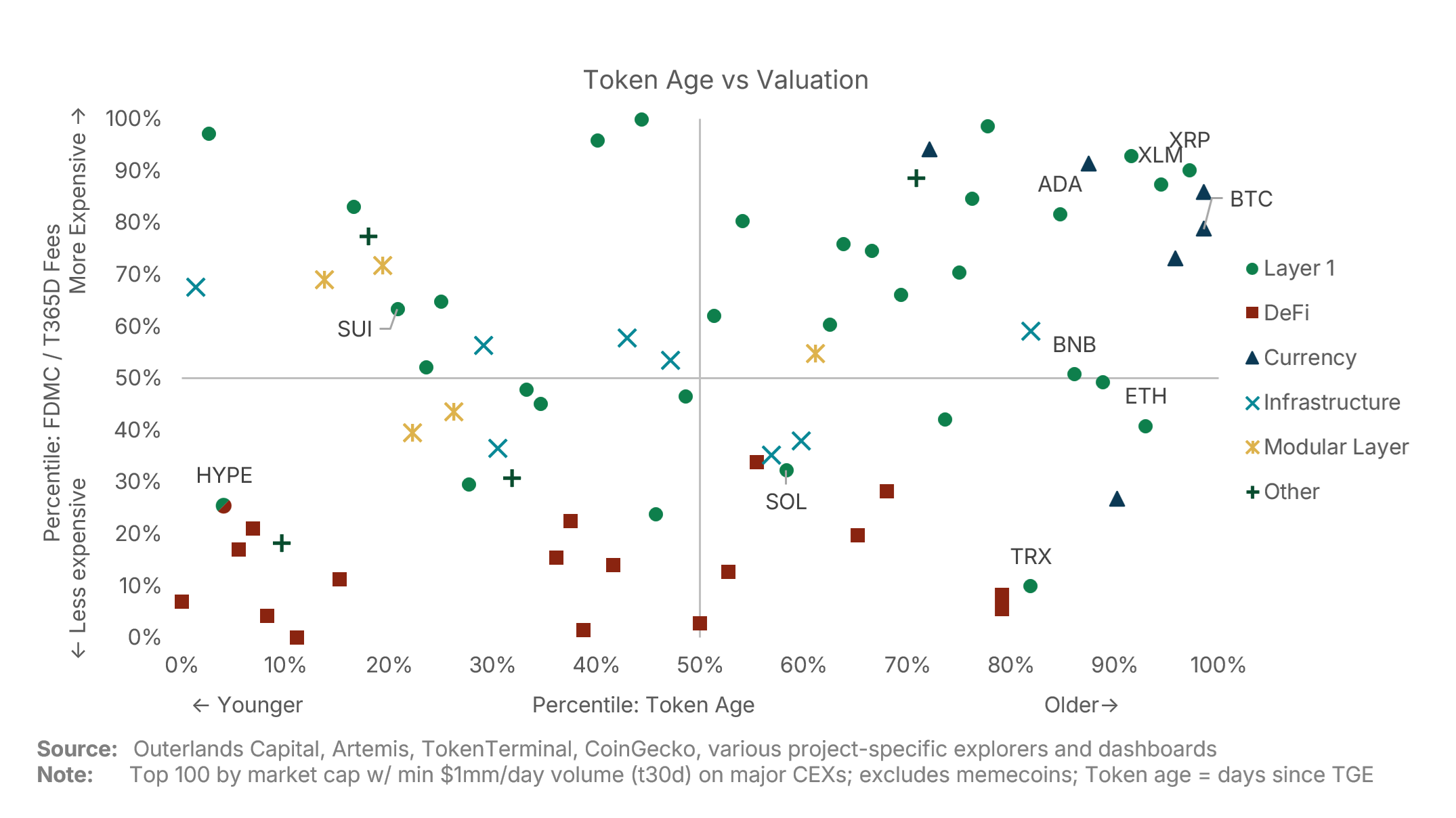
Continuing on the theme of fee-related valuation, we next take a quick look at valuation compared to age (again using fully diluted market cap to trailing 365 day fees, and using days since the token-generation-event for age). A glance at the largest assets by market cap shows a lot of older token projects: The top 10 have an average age of over 7 years, compared to the rest of the top 100 which has an average age of under 5 years. The question being: are projects getting a valuation boost simply because they’ve been around for a long time? In other words: is there a strong Lindy effect in crypto?
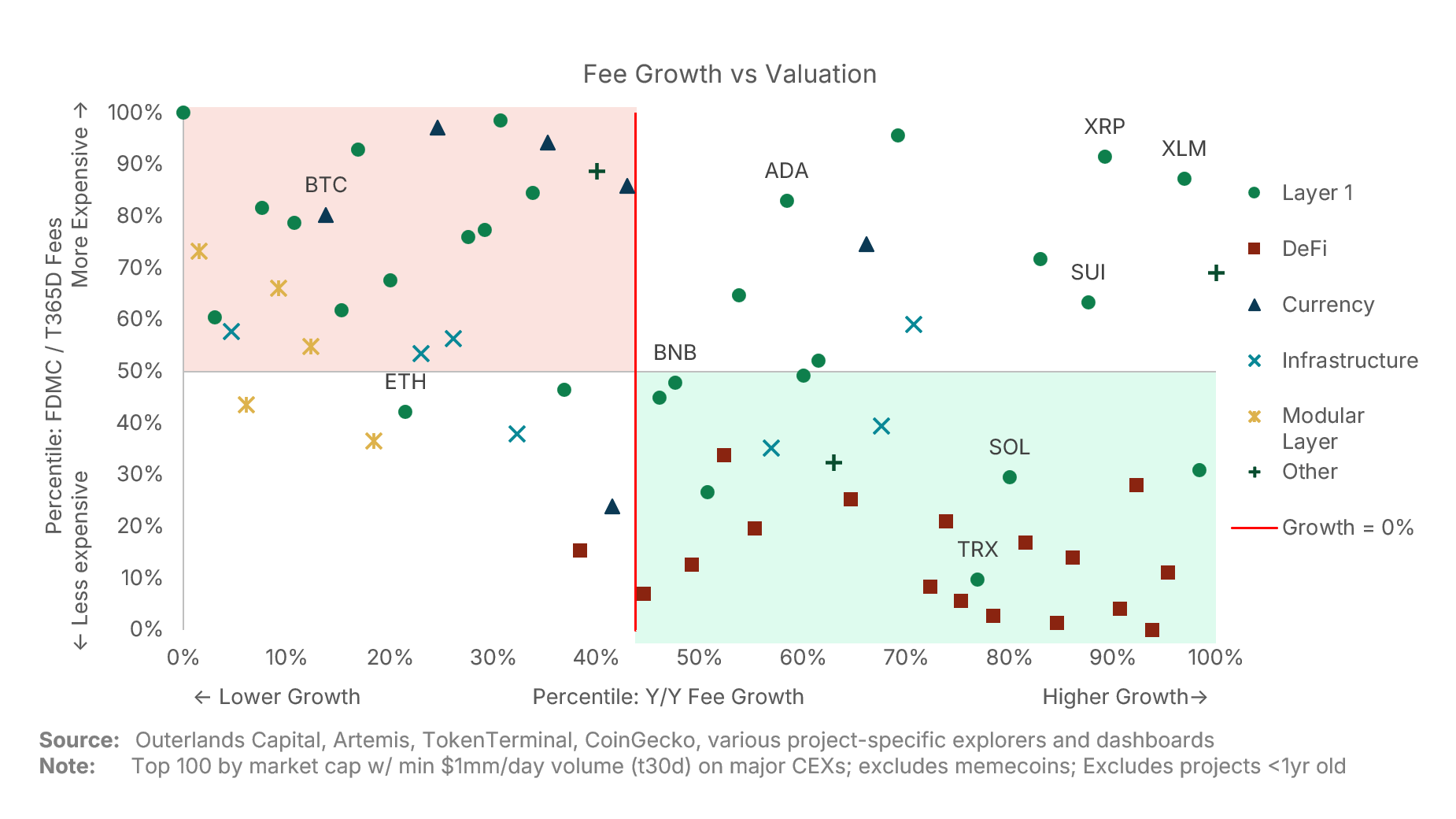
Last week, we compared top-line fees (transaction costs, fees, interest paid, etc.) to fully diluted market cap and noted the wide range of fee generation across digital assets, the Layer 1 premium, and Bitcoin’s unique position. This week, we add growth to the picture.
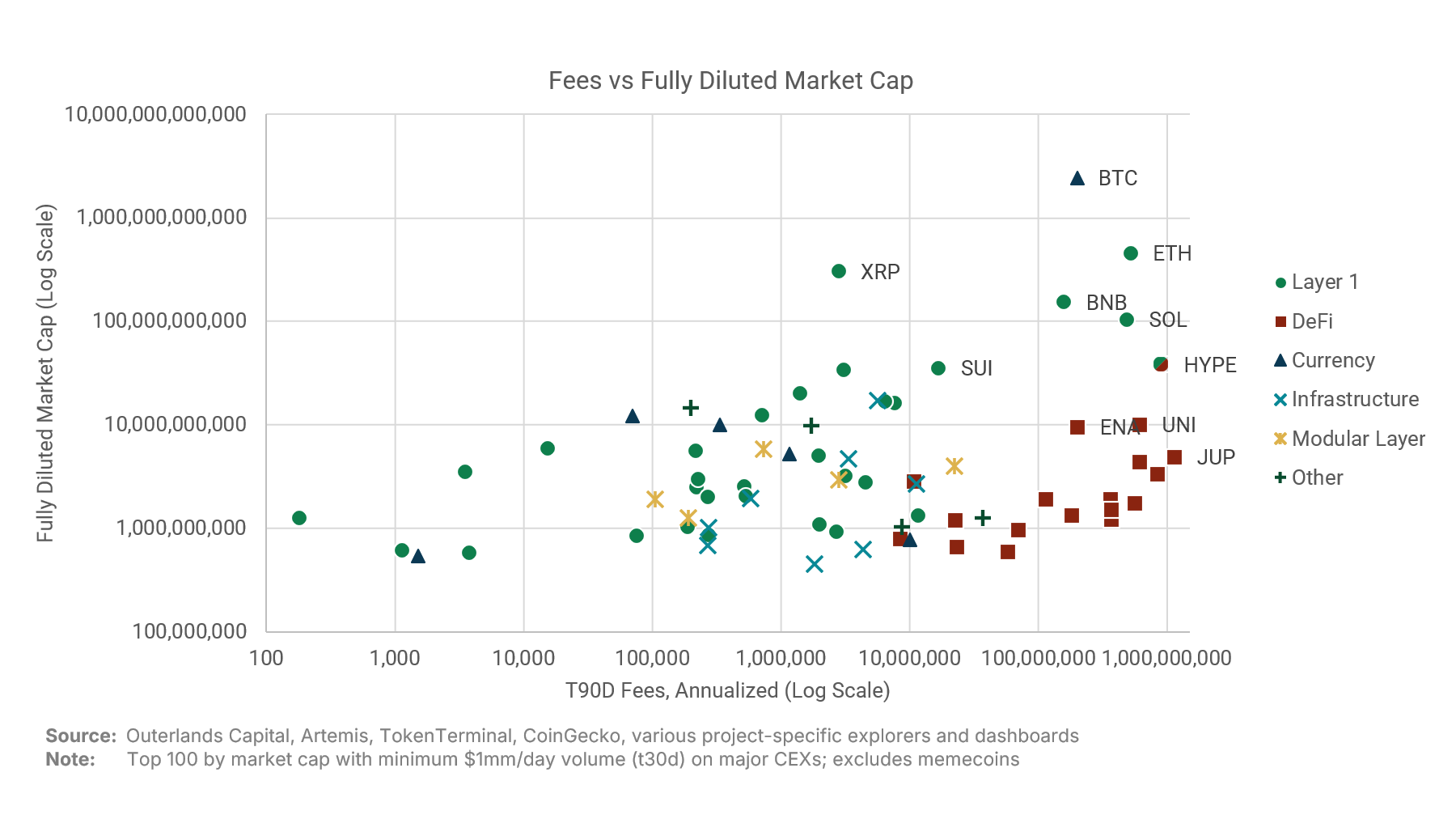
There are many ways to assess the value of a token. When we survey the landscape of crypto projects, we try to assess diverse aspects like fee generation, usage, addressable market, growth, and token structures that shape value accrual. Given the highly disparate nature of crypto projects, such exercises can become complex, especially when trying to compare projects, particularly across different sectors.
Sometimes it’s worth taking a step back and viewing the market through a more simplified lens.
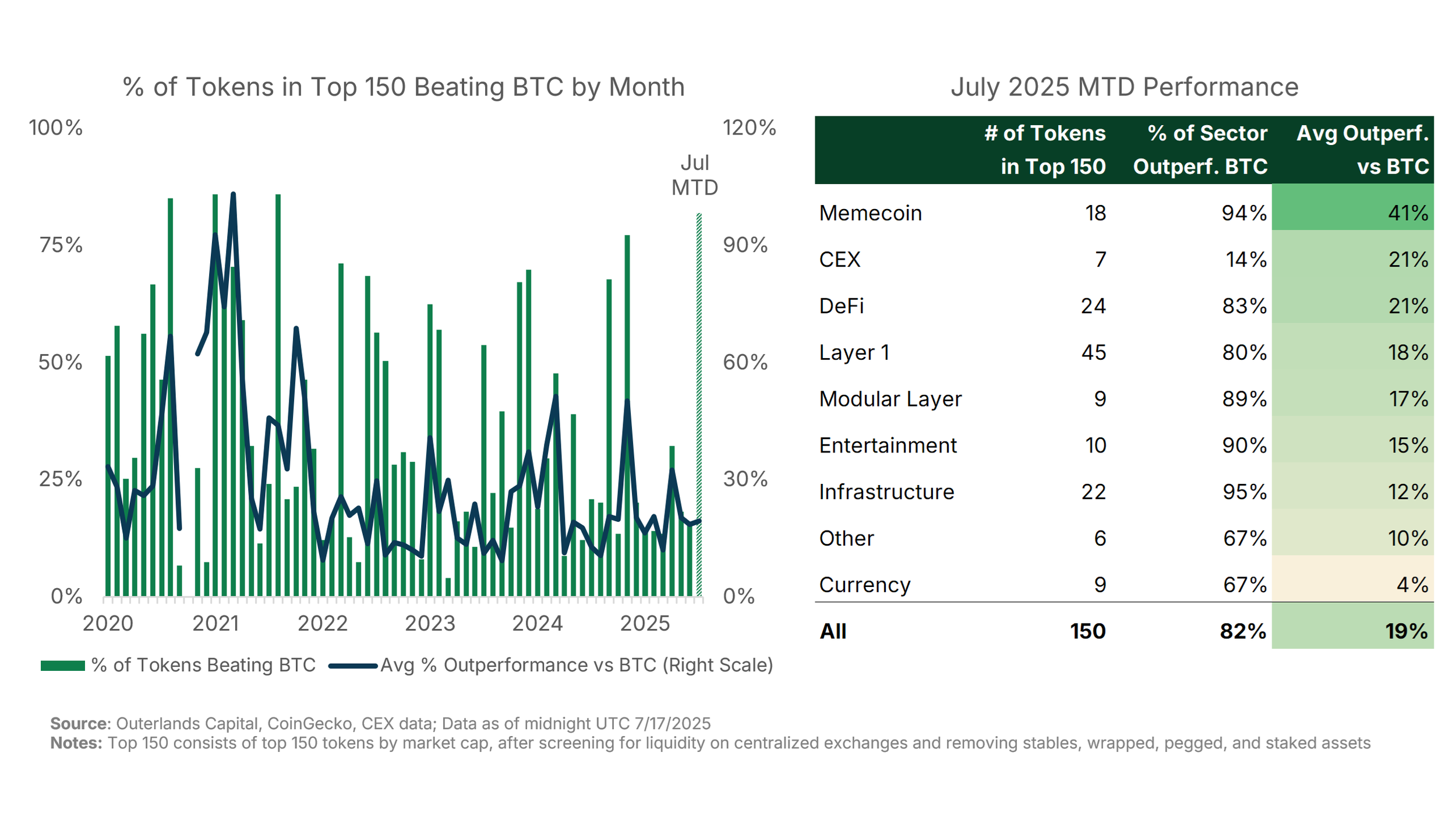
Bitcoin hit a fresh all-time-high this week, and ‘alts’ are heating up as well. Notably, over 80% of tokens in the Top 150 have outperformed Bitcoin month-to-date, by an average margin of ~19%. As altcoins rally, concerns about having “missed the opportunity” tend to surface. However, on average, these tokens are still trading at just 30% of their prior all-time highs, suggesting substantial potential upside remains. In fact, only a small subset of assets are currently trading within 5% of their historical peak.
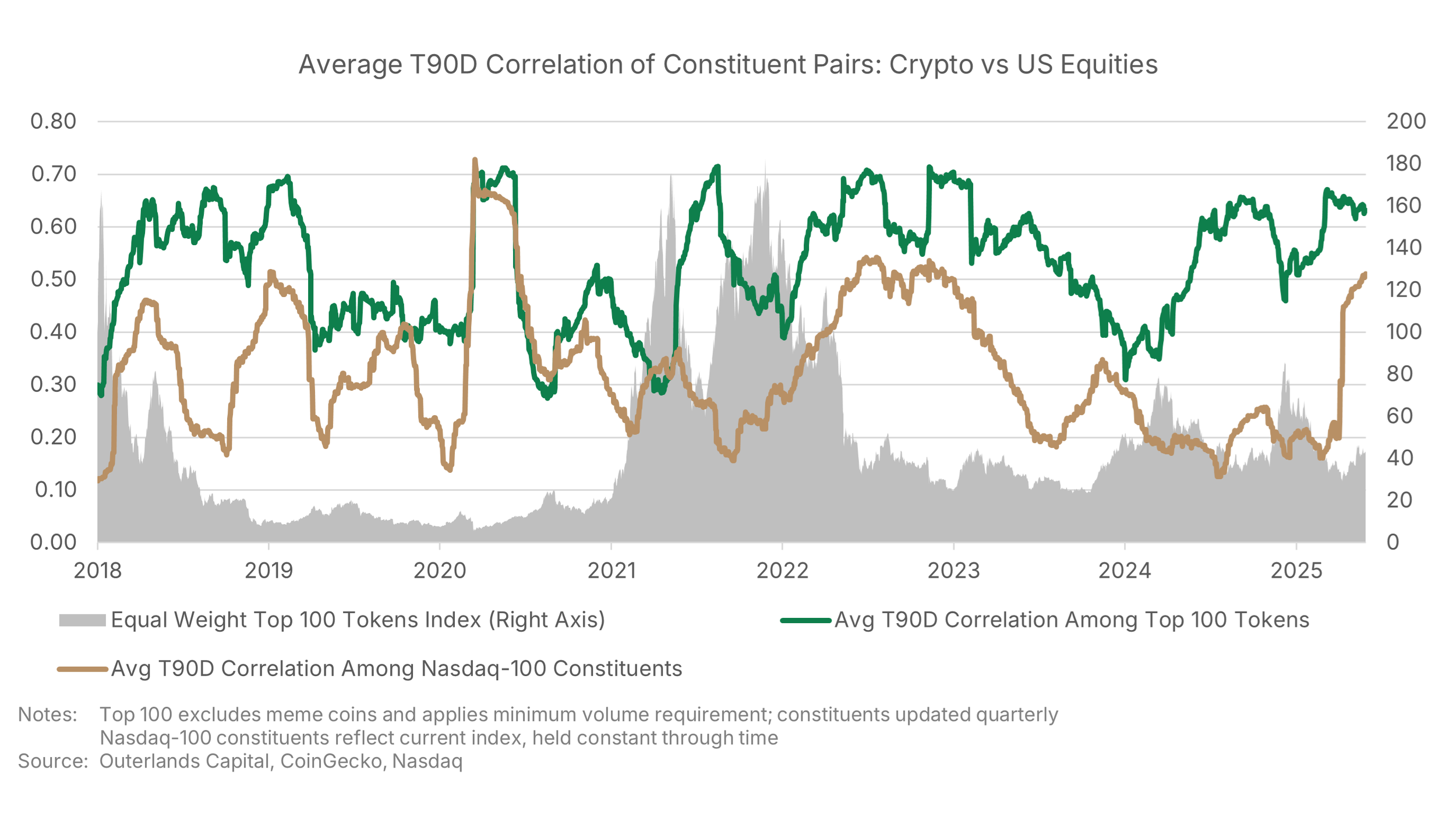
Amid recent market turbulence, we’ve revisited pairwise correlations - comparing the movements of tokens relative to other tokens in the top 100 and doing the same for stocks in the Nasdaq-100 index - and tracking how these relationships evolve. Since our last post on this subject in summer 2024, token correlations initially declined into year-end before rising again alongside Q1 geopolitical shocks.
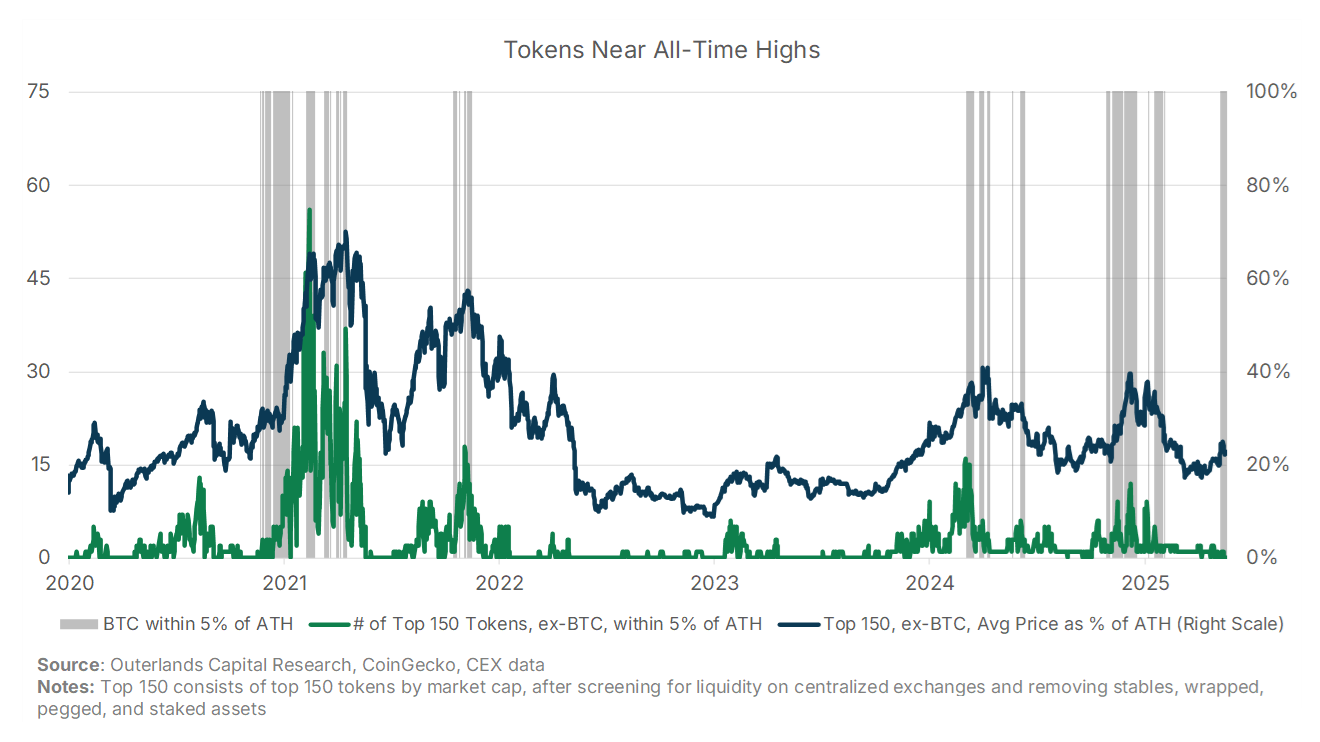
Bitcoin is at all-time highs again. But what about the rest of the digital asset space? Looking out at the Top 150 tokens by market cap, only a small handful have approached all-time-highs (ATH) in the last week. Those tokens have since fallen off those highs, leaving BTC the sole token in the Top 150 within 5% of its ATH. For comparison, as recently as the end of 2024, 12 other tokens were within 5% of their ATHs. On average, tokens in the Top 150 after BTC are trading at <23% of their all-time highs.
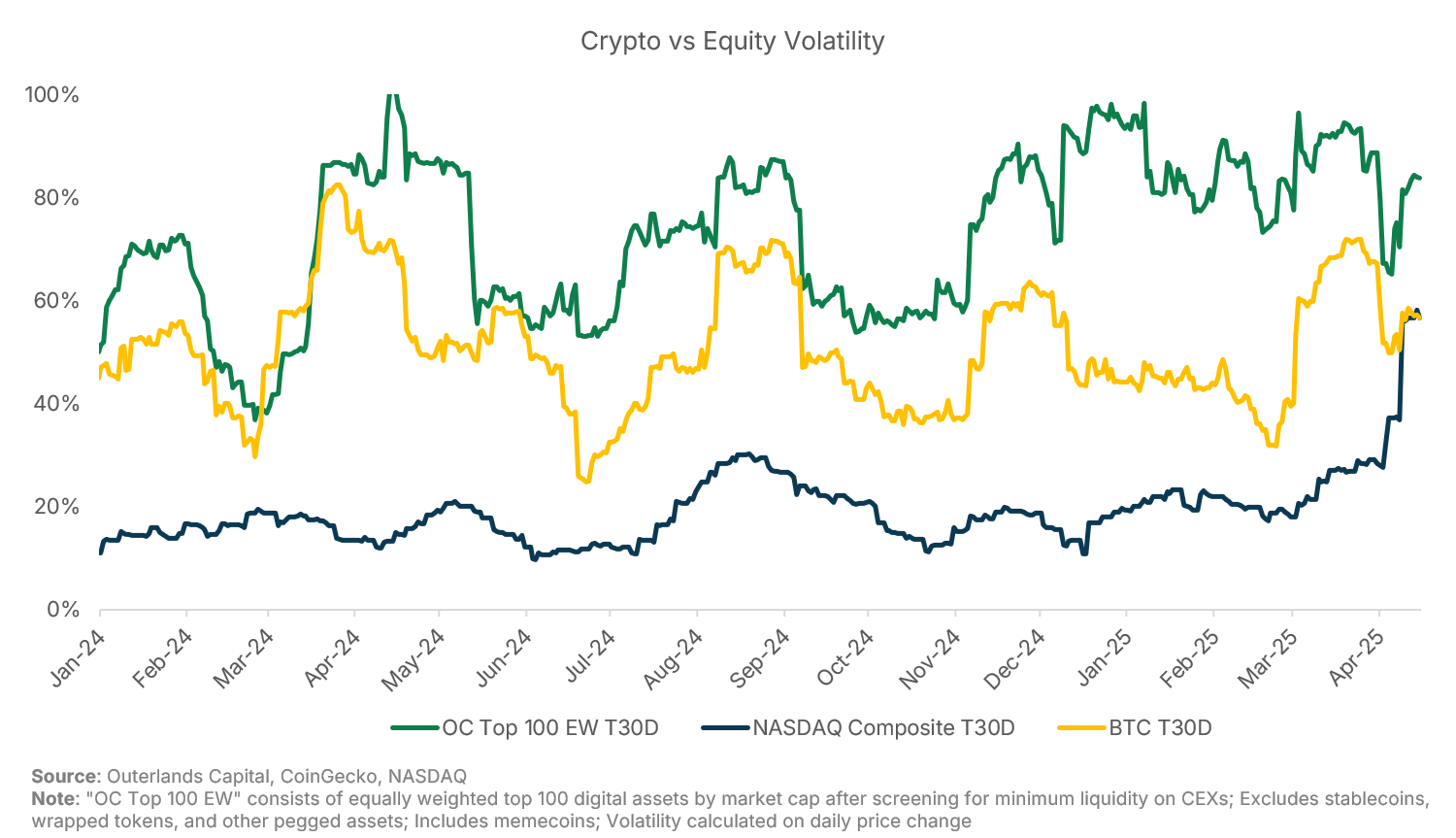
The macro environment has sent global markets into turmoil. Assets have notched extreme price moves across markets, but the relative magnitude of these moves vs history has varied– particularly in the comparison between digital assets and US equities.
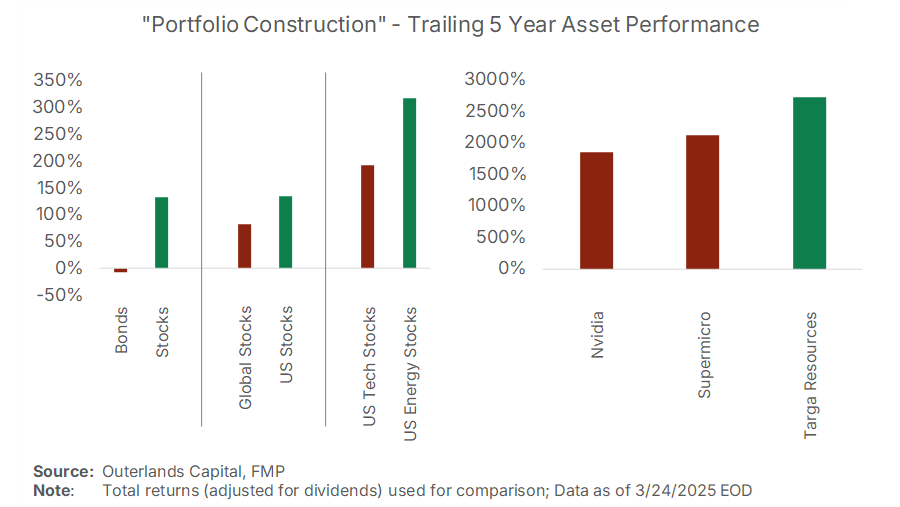
There seems to be a common approach to digital assets that looks at the performance and/or volatility of Bitcoin over the last few years vs other digital assets and concludes that Bitcoin alone makes for a satisfactory digital assets allocation.
In no other portfolio construction ‘process’ does this make sense - why should it in crypto?
SEC Registration does not imply a certain level of skill or training.